
Emergency RV AC Repair in Midland: What to Do First

Last Updated: November 1, 2026
Quick Summary
For emergency rv ac repair midland in Texas, first check the breaker, thermostat, and air filter yourself, then call a mobile technician if the unit trips the breaker again, blows warm air, or ices up. Treat a dead AC as an emergency if you are full-timing or the RV is your only shelter in Permian summer heat.
Reset a tripped AC breaker once; if it trips again, stop and call a pro.
Never swap a breaker for a larger one, because that removes protection and can start a fire.
If the fan blows but air never gets cold, you likely have low refrigerant or a failed compressor.
Shut off an iced-up unit and let it thaw before running it again to protect the compressor.
Basin RV offers 24/7 emergency support and a 90-day workmanship warranty on installations.
Table of Contents
Why RV AC Fails in Permian Basin Heat
When you need emergency RV AC repair Midland in Texas, know that an RV air conditioner in the Permian Basin runs under conditions most cooling systems were never engineered for. Summer highs in the region are very hot, and a rooftop unit baking in direct sun can run hotter than the outside air. When you call for emergency RV AC repair in Midland, Texas, the failure usually isn't random. It's heat, dust, and a system that's been asked to do too much for too long.
Three things break down first:
Refrigerant and seals. Vibration from travel plus constant thermal cycling wears on fittings until charge slowly leaks away. Cooling fades gradually, then stops.
The condenser coil. Permian dust and oilfield grit pack into the fins. Air can't pass, so the unit can't shed heat, and it runs hotter and harder until it quits.
Electrical connections. Extreme heat raises resistance at terminals and capacitors. A unit that worked fine in spring can fail to start by July.
RV AC Troubleshooting You Can Do Before Calling
Before you dial anyone, run through the basics yourself. Basic RV AC troubleshooting can often be done quickly and tells you whether you're facing a simple fix or a real breakdown. Here's what to check, in order.
Check Power, Breaker, and Thermostat First
Start at the power source.
Then look at the thermostat. Dead batteries, a mode set to "fan" instead of "cool," or a failed wall thermostat will make the unit seem broken when it isn't.
Watch out: never swap a breaker for a larger one to stop it tripping. That removes the protection and can start a fire in the wiring.
Inspect the Air Filter and Rooftop Unit
A clogged air filter chokes airflow, and poor airflow is behind a large share of "RV AC not cooling" complaints. Pull the filter, rinse or replace it, and check again. Then go up top. Look for leaves, dust, or debris blocking the condenser fins and confirm the fan spins freely.
If the rooftop unit is physically damaged, corroded through, or simply at the end of its life, a replacement may cost less than repeated repairs.
RV AC Not Cooling? What the Symptoms Tell You
Symptoms point to the cause, and reading them correctly saves you money. Use this as a quick diagnostic map before you call anyone.
Symptom | Likely Cause | DIY or Call |
Warm air, fan runs | Low refrigerant or bad compressor | Call a tech |
Unit won't start, no sound | Breaker, thermostat, or capacitor | Check basics first |
Weak airflow, some cooling | Clogged filter or dirty coil | DIY clean |
Ice on the coil or lines | Restricted airflow or low charge | Call a tech |
Trips breaker repeatedly | Electrical short or failing compressor | Call a tech |
Loud rattle or grinding | Fan motor or loose mount | Call a tech |
If the fan blows but the air never gets cold, you're most likely low on refrigerant or looking at a failed compressor. Both require a technician with gauges and the right parts. If the unit ices up, shut it off and let it thaw before running it again, because running an iced unit can damage the compressor.
When to Call for Emergency RV Repair in Midland
Call for emergency RV AC repair Midland in Texas when the AC won't run and the heat is dangerous, when you smell burning or see smoke, or when water is pooling inside from the unit. Those are stop-now situations, not wait-until-Monday situations.
Our rule of thumb: if you're full-timing in the RV or it's your only shelter in a Permian summer, treat a dead AC as an emergency. For a fuller picture of what qualifies as urgent, see our guide to 24/7 emergency mobile RV repair.
How Mobile RV Repair Works On-Site
Mobile RV repair brings the technician and the tools to your RV, so there's no towing and no waiting in a shop queue. That matters most when your rig is set up at a campground, a job site, or a spot you can't easily move.

The Dispatch Call
When you call, expect to answer a short set of questions before anyone is sent.
Give the dispatcher a callback number that works on-site and, if possible, a pin or address for the exact pad. In the Permian Basin, cell coverage can be spotty on rural lease roads, so confirm the best way to reach you before the call ends.
Realistic Arrival Windows
No honest mobile service can promise a precise minute during a summer heat wave, because call volume spikes when the temperature climbs. What a reputable shop will give you is a window and an update if it slips. Arrival timing depends on call volume and your location.
Ask up front whether there is an after-hours or emergency dispatch fee and when a technician will start a call.
Where Technicians Will Travel
Mobile service is only useful if the technician will actually come to you. Confirm the service area before you book. Travel distance can affect scheduling and any trip charge, so ask about service coverage for your location when you book.
Mobile work depends on the rig being safely parked with room for tools and a ladder. Repairs that require a fully equipped shop bay, such as major structural work, may need to be done in a shop.
What the Technician Tests On-Site
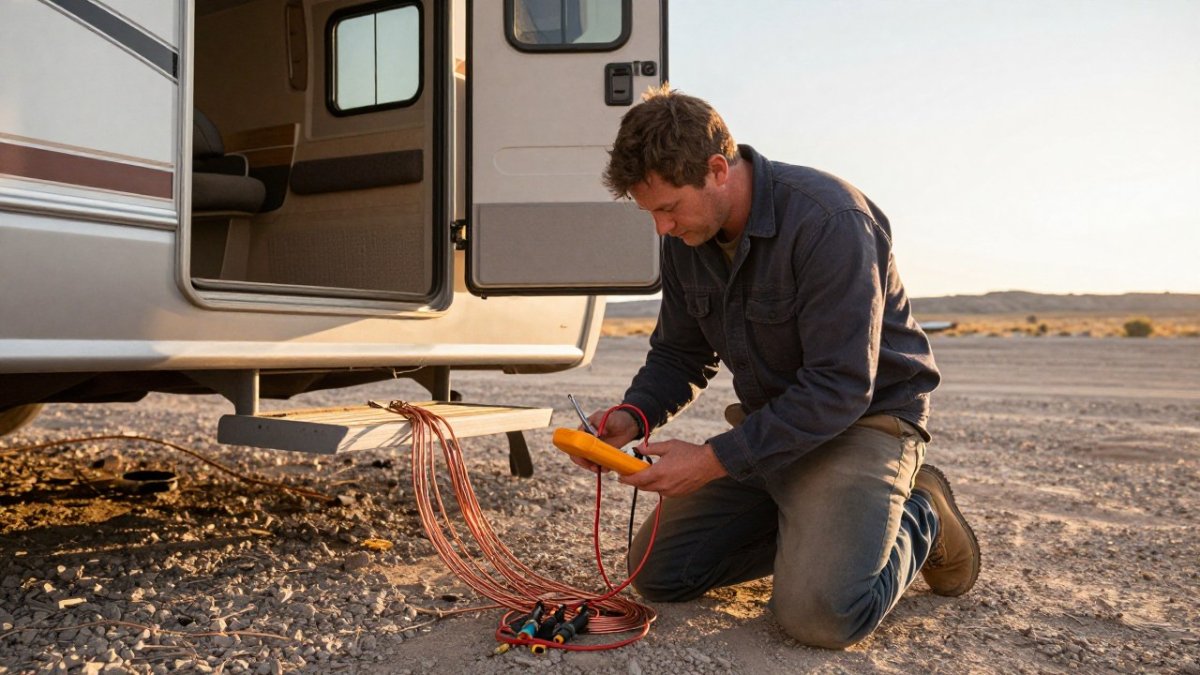
Once on-site, the technician confirms the symptoms you described and checks the simple causes first: power at the pedestal or generator, the AC breaker, the thermostat settings and batteries, and the filter. From there the diagnosis moves to the electrical system, the refrigerant charge, and airflow, using gauges and meters. Most AC problems can be diagnosed and repaired right where you're parked.
For a deeper walkthrough of the process, read our Permian Basin mobile RV repair guide.
What Emergency RV AC Repair Costs and What to Ask
Pricing for RV AC repair depends on the diagnosis, the parts, and the labor involved, so please request a quote for current pricing. What you can control is how transparent the estimate is and whether you understand what drives the final bill. Here is what actually moves the price and what to ask before anyone starts work.
The Cost Factors That Matter
Diagnostic or service-call fee. Ask whether a diagnostic or service-call fee applies and whether it goes toward the repair before the technician arrives.
Parts. A capacitor, thermostat, or fan motor is a relatively small part. A compressor or a complete rooftop unit is a major expense. The part number and whether it is new, refurbished, or used should be on the estimate.
Labor. Labor is usually billed by the hour or as a flat rate for a defined job. A simple part swap takes far less time than a refrigerant leak diagnosis and recharge, and the estimate should reflect which one you are getting.
Access and travel. A rooftop unit on a travel trailer is easier to reach than a ducted system buried behind cabinetry. Distance from the shop and any trip charge also affect the total.
Refrigerant. If the system is low, the technician has to find and repair the leak before recharging, or the charge will simply leak away again. That leak search is part of the cost.
Reading the Estimate
A useful estimate separates parts from labor, names the part, and gives a total including any applicable charges. Ask for the quote in writing before work begins.
Ask these questions before anyone starts work:
Is there a diagnostic or service-call fee, and does it apply toward the repair?
Is the quote for parts and labor combined, or separate?
Is the part new, refurbished, or used, and is it warrantied?
What's the total out-the-door price, including tax and any trip charge?
If the diagnosis changes once the unit is open, will you call me for approval before doing more work?
That last question matters. A technician who finds a second problem mid-repair should stop and get your approval rather than run up the bill. Our article on avoiding hidden RV repair fees walks through the charges that catch owners off guard.
Staying Safe in Extreme Heat While You Wait
Safety comes before comfort. While you wait for a technician, get the interior as cool as you can without the AC and watch for heat stress. West Texas summer heat can turn a closed RV into an oven within an hour.
Park in shade if you can, and cover sunny windows with Reflectix or towels.
Open windows and run a fan to move air; a battery or 12-volt fan helps when shore power is out.
Drink water steadily, and watch for confusion, nausea, or stopped sweating, which mean get to cooler air and help now.
Never run a generator inside an enclosed space or leave pets in the rig unattended.
If anyone in the RV shows signs of heat illness, leave the RV and get to air conditioning, a cooling center, or call 911. No repair is worth a medical emergency.
Book Your RV AC Repair with Basin RV
When the heat wins and your AC quits, you want a straight answer and a fast response, not a runaround. Basin RV is a family-run, LLC business that has served the Permian Basin for seven years, with 24/7 emergency support and mobile service that comes to your RV.
Get started with Basin RV and get your cooling back before the next hot afternoon. Book your service or call us to schedule a same-day visit.
Frequently Asked Questions
Who offers emergency mobile RV AC repair in Midland?
Basin RV provides 24/7 emergency mobile RV repair across the Permian Basin, including Midland and Odessa. A technician can come to your RV for on-site diagnostics, so you may not need to tow the unit anywhere. Basin RV backs installations with a 90-day workmanship warranty and is LLC, insured, and bonded.
What should I check before calling for RV AC repair?
Run through RV AC troubleshooting first: confirm the thermostat is set to cool, check the circuit breaker and shore power or generator supply, and inspect the air filter for heavy dust. Look at the rooftop unit for debris or roof damage. If the fan runs but the air stays warm, or the breaker trips repeatedly, stop and call for service. Sharing these findings helps the technician diagnose faster.
Can an RV air conditioner be repaired on-site?
Some RV AC problems may be addressed on-site with mobile RV repair. A full replacement or major rooftop work may need shop time depending on parts and roof condition. Ask the technician during the service call whether your issue is a mobile fix or a shop job before authorizing work.
How much does emergency RV AC repair typically cost?
Pricing depends on the diagnosis, parts and labor, and after-hours timing. Basin RV offers up-front pricing, and you can check the Basin RV pricing page or request a quote for current rates. Ask what the service call covers and whether the diagnostic fee applies toward the repair. For current rates, check the Basin RV pricing page or request a quote.
A dead AC in a Permian summer is more than an inconvenience; it's a safety issue. Basin RV answers the phone around the clock, brings the repair to your rig so you don't tow it anywhere, and tells you the price before the work begins. Get started with Basin RV and stay road-ready and cool, wherever you're parked.
Comments