
Emergency Mobile RV Repair: 24/7 Services Guide

Table of Contents
Emergency Mobile RV Repair 24/7 Services: What to Do First
Triage Your Breakdown Before You Call
The Breakdown Information Checklist
Emergency RV Roadside Repair: What a Mobile Technician Can Handle
How to Find a Mobile RV Technician Near Me
Verifying Credentials and Avoiding Scams
Emergency RV Repair Cost: What Drives the Bill
RV Repair Shop vs. Mobile Service: Which One Fits Your Situation
Scheduling, Service Area, and 24/7 Availability
Frequently Asked Questions
Last Updated: October 18, 2026
Emergency Mobile RV Repair 24/7 Services: What to Do First
A breakdown on the shoulder at 11 p.m. is a safety problem before it is a repair problem.
The single most important rule: get yourself and your passengers out of the travel lane and behind a barrier before you touch a phone. A mobile RV technician is a repair professional, not a traffic control crew.

Triage Your Breakdown Before You Call
Mobile RV repair is on-site diagnosis and repair by a technician who travels to your rig. Before you dial anyone, run this sequence:
Move off the travel lane. Pull as far right as the shoulder allows. If you cannot move, stay buckled and call emergency services first.
Set warning signals. Hazard flashers, then reflective triangles or cones behind the rig if you can place them safely.
Get people out of the vehicle on the traffic-free side. Wait behind the guardrail, not beside the coach.
Identify the symptom, not the cause. "No 12-volt power to the coach" is useful. "I think it's the converter" is a guess that can send the wrong parts.
Decide: safety issue or convenience issue? A brake, tire, or propane smell is a stop-now problem. A dead air conditioner in mild weather can wait for morning.
Watch Out Do not crawl under an RV on a highway shoulder to inspect a suspected brake or driveline problem. Traffic, soft ground, and a single jack stand are how people get killed. Leave that diagnosis to a technician with proper equipment.
The Breakdown Information Checklist
Dispatchers quote fast arrival times when they get complete information in the first call. Have these ready:
Your exact location, including mile marker, exit number, or campground site number
RV year, make, model, and length
Your cell number and whether you have reliable signal
The symptom in plain language, plus when it started
Whether the rig is drivable, and whether it is safe to move
Any warning lights, codes, or smells
Your power situation: shore power, generator, or battery only
Whether pets or mobility-limited passengers are aboard
Your insurance or roadside assistance policy number, if you plan to use it
A technician who knows your rig is a 32-foot fifth wheel with no shore power can load the right test equipment before leaving the yard.
Emergency RV Roadside Repair: What a Mobile Technician Can Handle
Most common breakdowns are fixable on site. Emergency RV roadside repair covers a wide slice of the failures that strand people, and knowing the boundary saves a wasted call.
What mobile techs typically handle roadside:
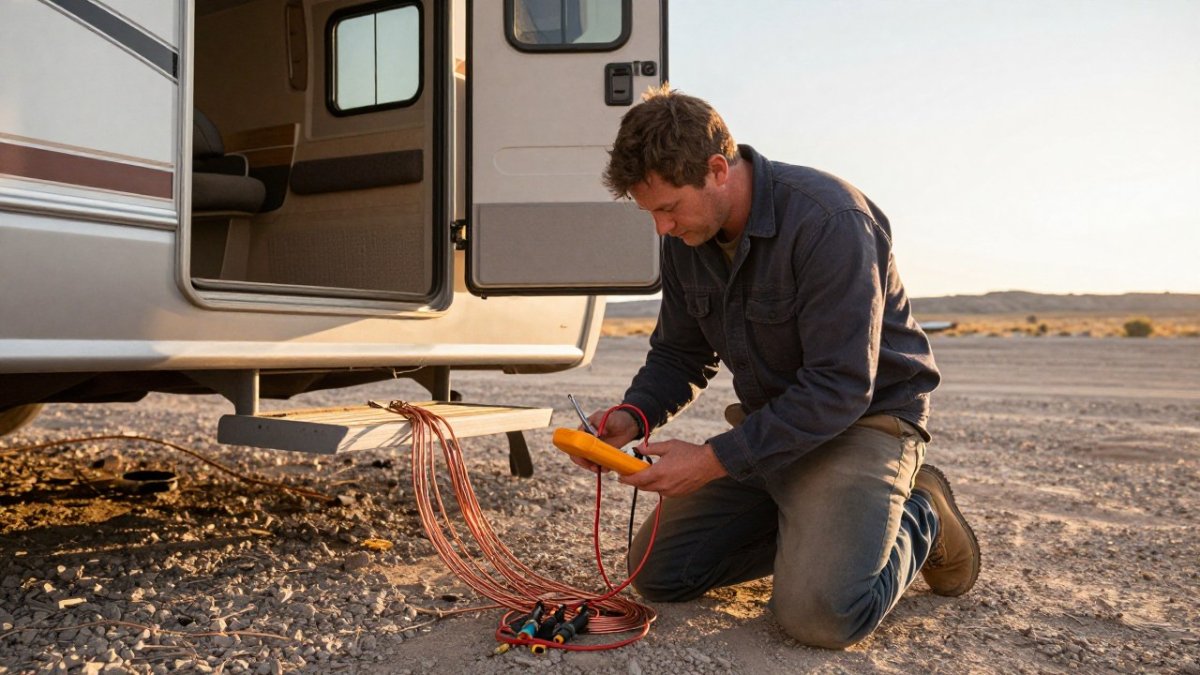
Battery, converter, and 12-volt electrical faults
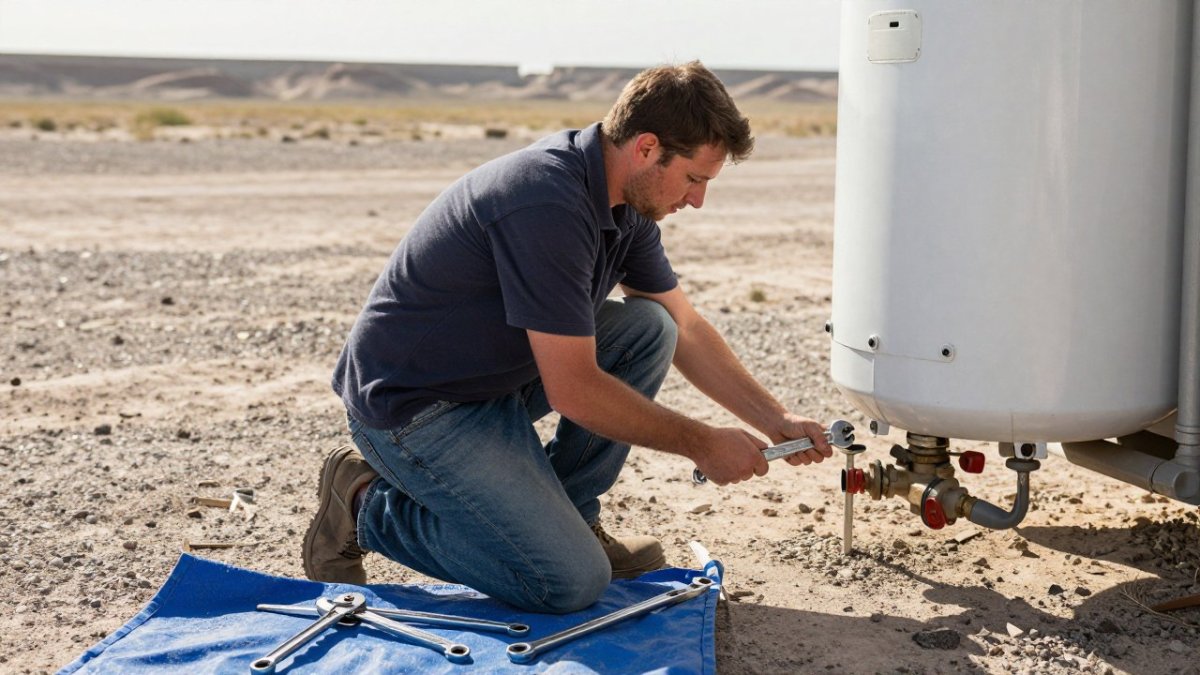
Appliance failures: refrigerator, water heater, furnace, air conditioner
Slide-out and leveling jack problems
Plumbing leaks and water pump failures
Generator no-starts and fuel delivery issues
Tire changes and wheel bearing checks on a serviceable shoulder
Awning, step, and entry door repairs
What usually needs a shop: frame and structural damage, roof replacement, axle and suspension replacement, extensive water intrusion repair, and anything requiring a lift or welding. A responsible technician will say when a job crosses that line instead of billing hours against a problem they cannot solve in a driveway.
Pro Tip If your rig is at a campground or storage lot, tell the dispatcher the site number and whether the campground has quiet hours or gate codes. A technician who arrives locked out at midnight is a technician who cannot help you.
How to Find a Mobile RV Technician Near Me
Searching for a mobile RV technician near me returns a wall of near-identical directory listings. The filter that matters is not the star rating but whether the technician is insured, bonded, and willing to put a warranty in writing.
Start with these questions on the first call:
Are you insured and bonded, and can you send proof?
Do you charge a diagnostic fee, and is it applied to the repair if I approve the work?
What is your workmanship warranty, and does it follow the repair or the location?
Can you give me an arrival window and a callback number?
Do you carry the parts for my system, or will we be waiting on a shipment?
Verifying Credentials and Avoiding Scams
Certification matters, but the paperwork that protects your money is insurance and a written estimate. Ask for the technician's certification details, then confirm them with the issuing body rather than taking a badge photo at face value. The RV Industry Association's technician certification program maintains a registry of certified RV technicians you can check before authorizing work.
Red flags that should end the call:
Cash-only payment demanded before diagnosis
No physical business address or verifiable phone number
Refusal to provide a written estimate
Pressure to approve a repair before anyone has looked at the rig
A price quoted over the phone with no caveats
A legitimate mobile technician will give you a range, explain what could move it, and put the estimate in writing. Basin RV backs installations with a 90-day workmanship warranty.
Emergency RV Repair Cost: What Drives the Bill
Emergency RV repair cost is not a single number, and any provider who quotes one over the phone before seeing your rig is guessing. The bill stacks four components; understanding each is how you compare quotes without surprises.
The four components of a mobile repair bill:
Service call / dispatch fee. A flat charge to send a technician to your location. This covers the truck roll, not the repair. Ask whether it is waived if you decline the repair after diagnosis.
Travel and mileage. Most providers include a set radius in the dispatch fee and charge per mile beyond it. Confirm the radius and per-mile rate before you commit, especially at a remote campground or mile marker far from town.
Diagnostic time. The labor to find the fault, billed hourly or as a flat diagnostic charge. Ask whether the diagnostic fee is credited toward the repair if you approve the work, many providers apply it, some do not.
Parts and repair labor. The actual fix, billed at the provider's labor rate plus parts. Parts availability is the wild card: a common part on the truck is fast and cheap, a specialty component may mean a second visit or a wait.
After-hours and weekend premiums are real. Overnight, holiday, and weekend calls typically carry a higher labor rate or separate surcharge. Ask for the after-hours rate specifically, not just the standard rate.
What a written estimate should contain before you approve work:
The dispatch fee and whether it is credited or refundable
The diagnostic charge and whether it applies to the repair
The labor rate, and whether an after-hours rate applies to your call
The parts cost, marked up or at list, and whether special-order parts require a deposit
The estimated total, stated as a range with the conditions that would move it
The workmanship warranty terms in writing
Key Takeaway Ask two questions before you approve work: "What is the total estimate in writing, and what would change it?" A transparent provider answers both without hesitation and puts the range in writing. If the answer is vague or the price only exists verbally, keep calling.
How to compare two quotes fairly. Line them up component by component, not by the bottom line. A lower dispatch fee with a higher per-mile rate can cost more at 60 miles out. A quote with no parts contingency is not cheaper, it is incomplete. The cheapest-looking quote is frequently the one that grows the most after the technician arrives.
What usually is not covered. Towing, campground fees, permits, and repairs you decline are typically separate.
RV Repair Shop vs. Mobile Service: Which One Fits Your Situation
The choice between an RV repair shop and mobile service comes down to whether the rig can move and how fast you need it back. Mobile service wins for appliance failures, electrical faults, leaks, and no-start conditions. The shop wins for structural work, major systems, and jobs that need a lift.
Situation | Best Option | Why |
No 12-volt power, dead fridge, failed AC | Mobile service | Diagnosed and fixed on site, no tow |
Brake, axle, or frame damage | Repair shop | Needs a lift and heavy equipment |
Breakdown on a highway shoulder | Mobile service, after you are safe | Avoids towing cost and delay |
Roof replacement or water intrusion | Repair shop | Multi-day structural work |
Pre-trip inspection before a long haul | Mobile service | Comes to your storage lot or driveway |
Warranty claim on a major component | Either, coordinated | Confirm approval path first |
The tow bill is the hidden variable. A mobile call that avoids a tow often costs less than the tow alone, which is why we push customers toward on-site diagnosis first whenever the rig is safely parked.
Scheduling, Service Area, and 24/7 Availability
Booking a mobile repair appointment should take one call and produce a written arrival window.
How real 24/7 dispatch works. True overnight coverage means a technician on call, an answering path that reaches a human, and a stated response window.
Questions that separate real coverage from marketing:
Is a technician on call tonight, or does my call roll to voicemail until morning?
What is your typical arrival window for my location at this hour?
Is there an after-hours surcharge, and what is the rate?
Do you dispatch from a fixed base or from roving technicians, and how does that change my wait?
Can you give me a callback number for the technician once dispatched?
How the travel radius affects your wait. Coverage works on a radius from a base or the nearest roving technician; calls inside the core radius get faster response than calls at the edge.
What to have ready to speed dispatch. Complete information gets a technician rolling faster.
Pro Tip If you are passing through and your AC fails in summer heat, call before you park for the night. A technician dispatched at 4 p.m. beats one dispatched at 10 p.m. every time, and the daytime rate is usually lower than the after-hours rate.
Scheduled maintenance beats emergency calls. For full-time RVers and oil field workers living in rigs, scheduled service beats emergency dispatch. Pre-trip inspections, annual appliance service, and electrical checks catch the failures that strand people. Basin RV offers on-site booking for emergency and scheduled work, and Ask a Tech consultations let DIY owners get technical advice.
Frequently Asked Questions
What should I do if my RV breaks down at night?
Pull as far off the roadway as you can, turn on hazard lights, and set out reflective triangles if you have them. Stay inside the RV if traffic is close, or stand well behind the guardrail if it is safe. Note your mile marker or nearest exit, then call a mobile RV repair service with 24/7 support. Avoid crawling under the rig in the dark. A mobile technician can usually diagnose electrical, appliance, and HVAC failures on-site, so you may not need a tow.
How much does emergency RV repair cost?
Emergency RV repair cost depends on the service call distance, after-hours timing, parts, and how long the diagnosis takes. Expect a service call fee plus labor, with parts billed separately. Ask for up-front pricing before work begins and confirm whether after-hours rates apply. Basin RV publishes pricing on its website and quotes jobs before starting, so you can compare the total against a shop visit. Get the estimate in writing when possible.
Can a mobile RV technician come to my campsite or roadside location?
Yes. A mobile RV technician near me search should return providers who travel to campgrounds, driveways, storage lots, and roadside pull-offs within their service area. Confirm the travel radius before booking, since some providers cap service within 100 miles. Have your exact location, rig type, and symptom ready. On-site repairs cover most appliance, electrical, and HVAC issues, while structural or chassis work usually needs a shop.
When does an RV need to be taken to a repair shop instead of fixed on-site?
Mobile service handles diagnostics, appliance repair, electrical faults, HVAC, plumbing, and many slide or leveling issues. Shop work is better for frame damage, major roof replacement, axle or suspension repair, and anything requiring a lift or welding. If the technician finds a problem beyond the mobile scope, they should explain why and coordinate the tow or shop appointment. Ask about the 90-day workmanship warranty on any installation before you approve the job.
Book Services
Comments