
.jpg)
RV Air Conditioner Repair or Replace? Decide Fast
- basinrvserv3
- Jul 27
- 5 min read
A rooftop AC that quits in Odessa heat is more than an inconvenience. It can make an RV hard to sleep in, unsafe for pets, and miserable to use as a home or travel stop. When deciding whether to handle an rv air conditioner repair or replace the unit, the right answer comes down to the failure, the unit’s age, available parts, and what the repair will actually cost.
The goal is not to replace equipment that still has useful life. It is also not to keep putting money into an unreliable unit that could fail again during the next trip. A clear diagnosis gives you the information to make a practical call.
RV Air Conditioner Repair or Replace? Start With the Failure
Many AC problems look the same from inside the coach: weak airflow, warm air, a breaker that trips, or a unit that hums but will not start. The cause can be minor, such as a dirty filter or weak start capacitor, or it can be a major compressor or refrigerant-system issue.
Start with the basics. Make sure the RV is receiving proper power, especially when connected to campground electric or a generator. A low-voltage condition can keep an air conditioner from starting correctly and can damage components over time. Check that the thermostat is set to cool, the breaker is not tripped, and the filter and return-air opening are not blocked by dust, pet hair, or loose material.
If the unit is running but not cooling, do not assume it needs refrigerant. RV rooftop air conditioners are typically sealed systems. They do not use refrigerant like a vehicle with a simple refill port. A refrigerant leak usually requires locating the leak and performing sealed-system work, which often changes the repair-versus-replace calculation.
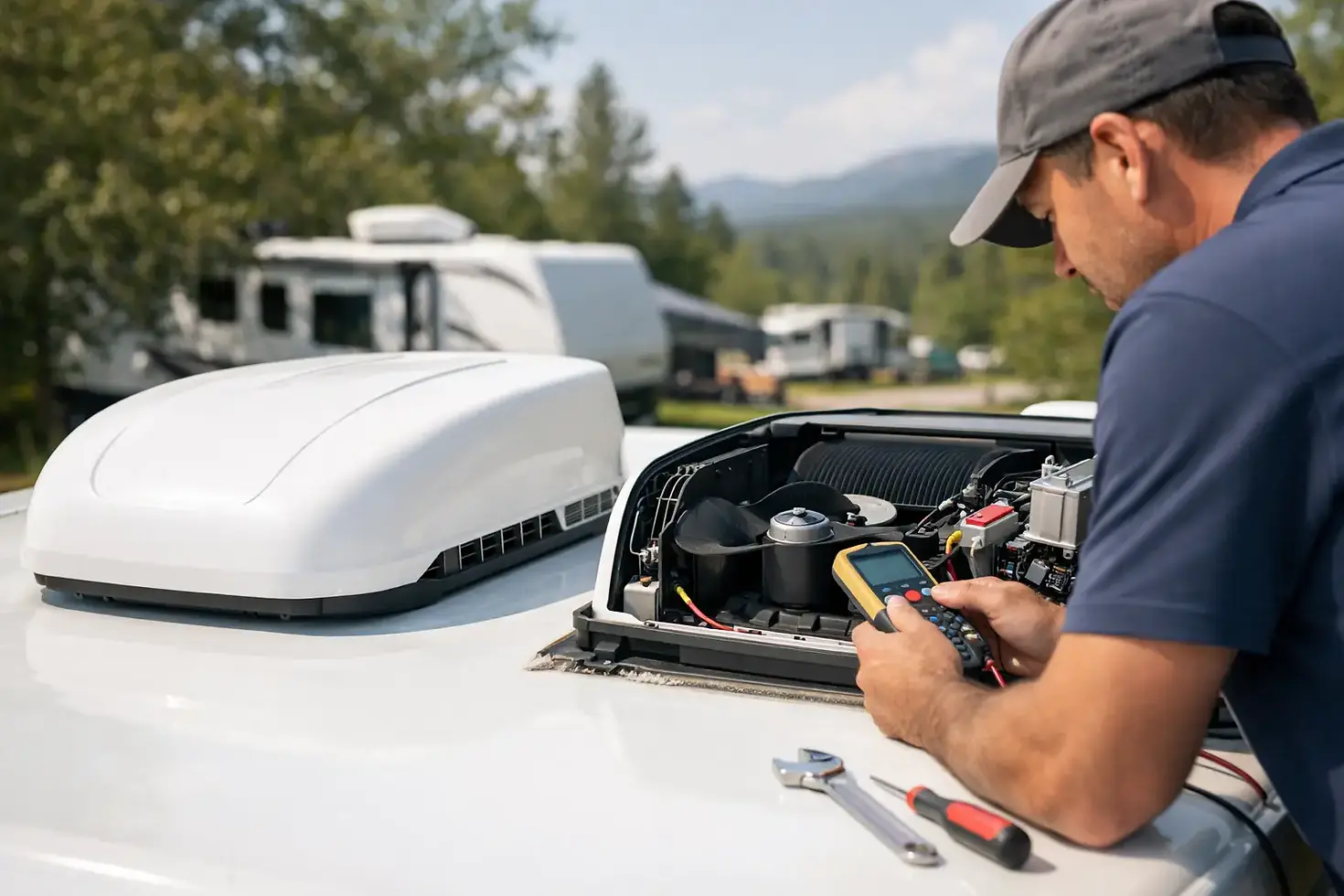
A technician should also inspect the roof gasket, wiring connections, capacitors, fan motor, control board, evaporator coil, condenser coil, and compressor operation. That inspection matters because replacing a thermostat will not fix a failing compressor, and installing a new AC will not solve a weak campground power supply.
Repairs That Usually Make Sense
A repair is often the smart choice when the air conditioner is reasonably new, the cabinet and coils are in good shape, and the fault is limited to a serviceable part. Common repairs can restore dependable cooling without the cost of a complete rooftop unit.
A failed start or run capacitor is one example. These components help the fan motor and compressor start and run. When one fails, the unit may hum, start slowly, trip a breaker, or fail to come on at all. Replacing a capacitor is usually far more reasonable than replacing the full air conditioner.
Fan motor issues can also be repairable. If the blower is noisy, airflow is weak, or the fan will not turn while the compressor tries to run, the motor, blade, or related electrical component may be the problem. A control board, thermostat, relay, or damaged wire can create similar symptoms and may be repairable if replacement parts are available.
Cleaning can make a real difference, too. Dirty evaporator and condenser coils restrict heat transfer. A clogged filter restricts air movement and can contribute to coil freeze-up. Routine maintenance will not revive a worn-out compressor, but it can correct performance problems before they become larger repairs.
Repair is generally the better route when the estimate is modest compared with replacement and the unit has not shown a pattern of repeated failures. If the AC has cooled well for years and needs one identifiable part, fixing it is usually the no-nonsense choice.
When Replacement Is the Better Investment
Replacement becomes more practical when the compressor has failed, the sealed refrigerant system is leaking, the coils are badly corroded, or compatible parts are no longer available. These repairs can be labor-intensive and may not leave you with a unit you can count on through another West Texas summer.
Age matters, but it is not the only factor. Many RV air conditioners provide around 10 to 15 years of service when maintained well. A younger unit can still need replacement after storm damage, electrical damage, or severe corrosion. An older unit may still be worth repairing if the issue is simple and the rest of the system is sound.
Repeated service calls are a strong warning sign. One capacitor replacement is normal maintenance. A history of electrical failures, poor cooling, noisy operation, leaking seals, and intermittent shutdowns points to a unit that may be nearing the end of its useful life. Paying for another temporary repair may cost more than installing a replacement that gives you a clean start.
A replacement can also make sense when your needs have changed. If the original unit struggled to cool a larger RV, a better-matched replacement may improve comfort. Still, bigger is not automatically better. The new unit must match the roof opening, electrical service, ducted or non-ducted setup, thermostat compatibility, and available generator capacity.
Compare the Full Cost, Not Just the Part Price
The cheapest part is not always the least expensive solution. A complete repair estimate should account for diagnosis, labor, required components, roof access, wiring work, and the likelihood of another failure. A replacement estimate should include the new unit, installation materials, removal and disposal of the old unit, and any thermostat or electrical changes needed for compatibility.
Ask a straightforward question: after this repair is completed, what condition will the rest of the unit be in? If the answer is that the AC should run reliably for several more seasons, repair may offer good value. If the repair addresses only one issue on an aging unit with worn coils or compressor concerns, replacement may protect you from another breakdown soon.
Transparent pricing matters here. A dependable service provider should explain what failed, what repair involves, what replacement involves, and why one option makes more sense for your RV. You should not have to guess whether a recommendation is based on the equipment or on selling the highest-cost option.
Do Not Ignore Power and Roof Problems
Some air conditioner failures begin outside the AC itself. Low voltage, a loose shore-power connection, undersized extension cords, a weak generator, or a failing power converter can create electrical problems that look like a bad rooftop unit. If the new AC is installed without correcting the power issue, the replacement may be at risk.
Roof conditions matter as well. A damaged rooftop gasket can allow water into the ceiling or walls. That can lead to rot, staining, electrical damage, and much more expensive repairs than the air conditioner issue alone. When an AC is removed or replaced, it is a good time to inspect the roof opening, mounting surface, and seal.
Because rooftop AC systems involve high voltage, stored electrical charge in capacitors, and roof work, this is not a repair to approach casually. Turning off the breaker does not always eliminate every hazard. If you are unsure of the diagnosis or do not have the right equipment, professional mobile service can save time and prevent further damage.
Choosing the Right Replacement Unit
Before ordering a new air conditioner, confirm the existing unit’s dimensions, roof opening size, electrical requirements, duct configuration, and thermostat setup. Most RV rooftop openings are similar, but assumptions can create installation delays. A heat-pump model may add cold-weather capability, while a standard cooling unit can be the simpler choice for many owners.
Cooling capacity should fit the RV, not just the old label. Larger coaches, units with many windows, poor insulation, or frequent sun exposure may need more cooling capacity or a second AC. On the other hand, installing equipment that exceeds the available electrical capacity can create startup and breaker problems.
Basin RV can help RV owners in Odessa and surrounding West Texas sort through the failure, source needed parts, and get a repair or replacement handled without the runaround. Fast service matters most when the forecast is climbing and your RV cannot wait.
If your air conditioner is blowing warm air, tripping breakers, leaking, or making new noises, address it before the next trip. A quick diagnosis now can be the difference between a manageable repair and a long, hot delay on the road.



Comments