
.jpg)

Emergency RV Roadside Checklist for West Texas
- basinrvserv3
- Aug 4
- 6 min read
A blown tire outside Odessa, a dead battery at a fuel stop, or an air conditioner that quits during a hot West Texas afternoon can turn a normal travel day into a real problem fast. This emergency RV roadside checklist helps you handle the first few minutes safely, protect your RV from further damage, and give a repair technician the information they need to respond.
Emergency RV Roadside Checklist: Start With Safety
Before troubleshooting, get yourself, your passengers, and your RV out of immediate danger. A repair can wait a few minutes. Traffic, heat exposure, leaking propane, and electrical hazards cannot.
If your RV can still move, pull as far off the roadway as conditions safely allow. Avoid soft shoulders, ditches, and areas where the RV may sink or lean. Set the parking brake, place the transmission in park, turn on hazard lights, and put out reflective triangles or road flares if it is safe to do so. Keep people away from the traffic side of the RV.
In West Texas, heat and distance matter. Keep drinking water available, especially if you are stopped where there is little shade or cell service is weak. If the RV is on a busy highway, has a fuel or propane leak, is smoking, or has a fire risk, move away from the vehicle and call emergency services first.
Your immediate roadside checklist should include these basics:
Check everyone for injuries and move passengers to a safe location.
Turn on hazard lights and place warning devices behind the RV.
Set the parking brake and chock the wheels if the RV is parked on an incline.
Look and listen for smoke, flames, fuel leaks, propane odor, or sparking wires.
Take photos of the issue, your location, and any visible damage.
Save your exact location, including highway number, mile marker, nearest town, or campground site number.
Do not crawl under an RV parked on an unstable shoulder. Do not attempt a tire change beside fast traffic. Do not keep resetting a breaker or replacing a fuse if you smell burned wiring. Those are situations where a quick call for professional help can prevent a larger repair bill.
Identify the Problem Without Making It Worse
Once the scene is safe, take a calm look at what failed. You do not need to diagnose every part. The goal is to narrow down the problem and avoid actions that cause damage.
Tire, Wheel, or Suspension Trouble
A tire blowout is one of the most common roadside RV emergencies. If a tire fails while moving, hold the steering wheel steady, ease off the accelerator, and avoid slamming on the brakes. Let the RV slow gradually before pulling over.
After stopping, inspect from a safe distance. Look for shredded tire material around the wheel well, damaged brake lines, bent fenders, or loose wiring. On trailers, check the remaining tires and wheel bearings. A single failed tire can overload the others, especially on a fully loaded unit.
Carry a properly rated spare, lug wrench, jack, and solid jack base only if you know your RV can be safely lifted with that equipment. Many motorhomes and larger trailers require heavier tools or roadside service. Replacing a tire is not worth risking an unstable RV or personal injury.
Engine, Tow Vehicle, or Battery Failure
If the engine will not start, begin with the simple checks. Confirm the transmission is in park or neutral, verify the battery disconnect has not been switched off, and check whether the dash lights come on. A clicking sound often points to a weak battery or poor cable connection. No power at all may mean a disconnected battery, blown fuse, or failed battery disconnect.
For a towable RV, the tow vehicle is the priority. Check engine temperature, warning lights, tire condition, hitch connection, safety chains, breakaway cable, and trailer brake connection. Never continue driving with an overheating engine, a loose hitch, or brake warning lights. A short delay can become a major mechanical failure if you push it.
If you use jumper cables or a jump pack, connect them correctly and follow the equipment instructions. Keep sparks away from batteries, fuel, and propane compartments. If the battery repeatedly dies, do not assume it is only an old battery. A converter, charging system, cable, or parasitic draw may be the real issue.
Electrical Problems Inside the RV
Loss of shore power, tripped breakers, and failed converters can shut down much of an RV at once. Start by checking whether the campground pedestal or generator is providing power. Then inspect the RV's main breaker panel and any GFCI outlets. One tripped GFCI can disable several outlets.
If the breaker trips again immediately, leave it off. Repeated resets can overheat wires or damage appliances. Unplug high-draw items such as portable heaters, coffee makers, air fryers, and water heaters before testing the circuit again. Also check the power cord and plug for heat damage, discoloration, loose pins, or melted plastic.
A generator that runs but does not power the coach may have a breaker issue, transfer switch problem, or connection failure. Avoid opening electrical panels unless you are trained and the power source is disconnected. Electrical repairs often look simple until a loose wire or failed component causes more damage.
Water, Sewer, or Plumbing Emergencies
A leaking water line can empty a fresh tank or flood cabinets quickly. Shut off the water pump, disconnect city water if you are hooked up, and open a faucet to relieve pressure. Dry the affected area as soon as possible, then look for loose fittings, cracked hose connections, or a failed water heater relief valve.
If the leak is at the water heater, do not operate it until the cause is found. A water heater should never be fired when the tank is empty. If you smell propane near the water heater or refrigerator, shut off the propane supply at the tank and do not use electrical switches or open flames nearby.
For sewer trouble, wear gloves, keep a separate set of cleanup supplies, and avoid forcing a blocked valve. A damaged sewer hose or loose connection is unpleasant, but rushing the job usually makes the spill larger. Carry a backup sewer hose, fittings, disposable gloves, disinfectant, and absorbent towels.
What to Keep in Your RV for Roadside Problems
The right supplies will not fix every failure, but they can keep a small problem from becoming a stranded situation. Store emergency items where you can reach them without unloading half the RV.
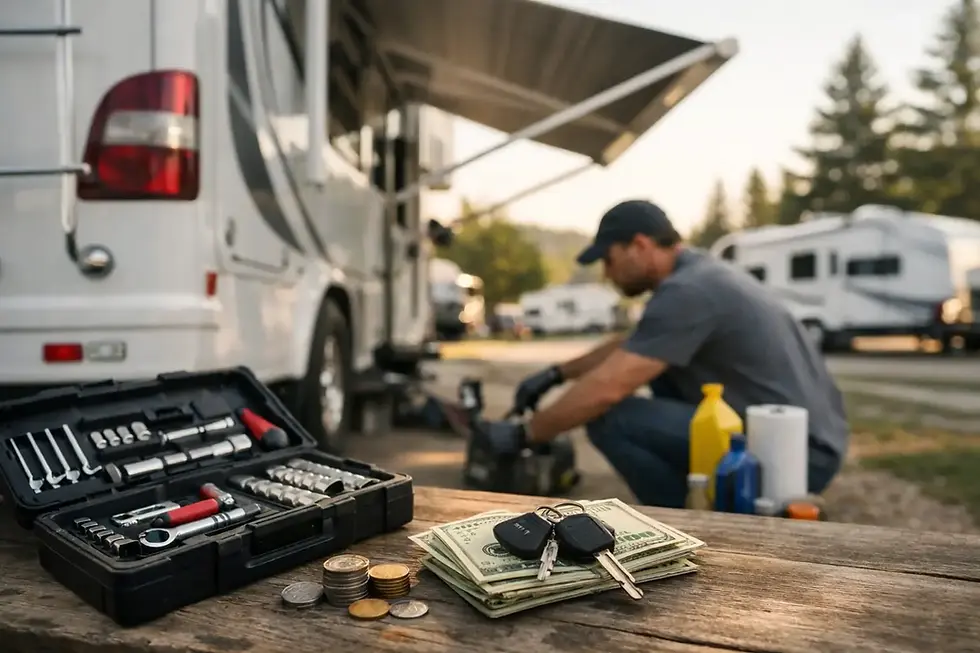
Your kit should include reflective triangles, a flashlight with spare batteries, work gloves, a basic first-aid kit, drinking water, tire pressure gauge, portable air compressor, wheel chocks, jumper pack, fire extinguisher, duct tape, electrical tape, zip ties, assorted fuses, and basic hand tools. Add a multimeter if you know how to use one safely.
For RV-specific needs, keep a drinking-water hose, sewer hose and fittings, leveling blocks, spare light bulbs, replacement water filters, appropriate electrical adapters, and a surge protector. A small supply of common parts can also save time, including hose washers, plumbing fittings, a 12-volt fuse assortment, and spare battery terminals.
Check these items before longer trips. Tire age and pressure, battery condition, propane level, roof seal condition, brake controller operation, and emergency tool access are easier to handle in your driveway than on the shoulder of a highway.
Information That Speeds Up Roadside Repair
When you call for mobile RV help, clear details save time. Be ready with the RV year, make, model, length, and whether it is a motorhome, fifth wheel, travel trailer, or camper. Explain the problem in plain terms: what happened, when it started, what warning lights are on, what you smell or hear, and what you have already tried.
Your location matters just as much. Give the road name, direction of travel, nearest mile marker, exit number, or visible landmark. At a park, provide the campground name and site number. Let the technician know whether the RV is accessible, whether it is hooked to a tow vehicle, and whether you have shore power, generator power, or no power at all.
Basin RV serves RV owners in Odessa and the surrounding West Texas area with mobile repair and emergency support for common road and campsite failures. Fast service starts with accurate information, so a few photos and a clear description can help identify needed parts before the technician arrives.
Know When to Stop and Call for Help
Some problems are not roadside fixes. Stop using the RV and get help for a propane leak, smoke or electrical burning smell, active fire, damaged brake lines, major tire or suspension damage, fuel leaks, severe overheating, or an RV that is leaning or unstable. The same applies to a toilet or sewer issue that has contaminated living areas.
For smaller issues, use good judgment. A tripped GFCI or loose water fitting may be manageable if you know the system and have the right tools. A failed converter, damaged power cord, broken slide-out mechanism, or water heater fault is usually better handled by a qualified RV technician.
Keep this checklist with your registration and insurance information, then review it before each trip. When something fails, the best first move is rarely the fastest repair. It is making the area safe, preventing more damage, and getting reliable help on the way.


Comments