
.jpg)
Guide to RV Electrical Troubleshooting
- basinrvserv3
- Jun 25
- 6 min read
The lights flicker, the outlets quit, or the battery suddenly looks dead right when you are getting settled in. That is usually how the need for a real guide to RV electrical troubleshooting starts - not in a shop, but in a campsite, a driveway, or on the side of the road when you need answers fast.
RV electrical problems can look complicated because your rig has more than one system working together. You have 12-volt DC power for lights, water pumps, fans, and many control boards. You also have 120-volt AC power for things like microwaves, air conditioners, and standard wall outlets. Add in shore power, batteries, converters, inverters, fuses, breakers, and transfer switches, and a small issue can feel bigger than it is.
The good news is that many electrical problems follow a pattern. If you check things in the right order, you can often narrow the problem down quickly and avoid replacing parts you do not need.
Guide to RV electrical troubleshooting: start with safety
Before touching anything, slow down and make sure you are working safely. RV electrical systems can cause shock, damage appliances, or create a fire risk if handled carelessly. If you smell burning plastic, see melted wiring, notice heat at a plug or panel, or find repeated breaker trips with no obvious cause, stop there. That is no longer basic troubleshooting.
For routine checks, start by turning off large loads like the air conditioner, microwave, and water heater electric mode. If you are opening any panel, disconnect shore power first. If you are working around the battery, avoid loose metal jewelry and use insulated tools when possible.
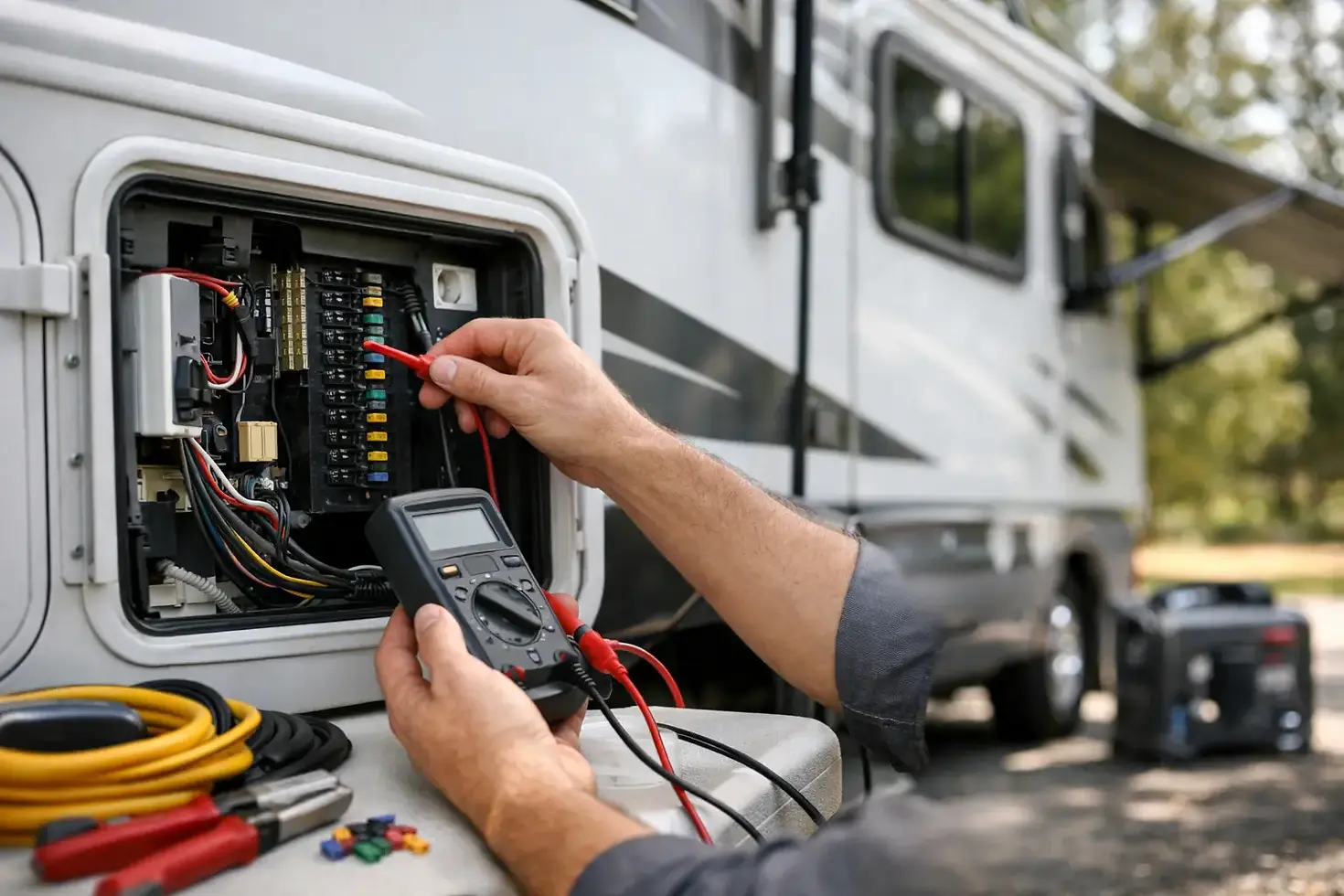
A basic multimeter is the most useful tool here. It does not need to be expensive. You just need a dependable one that can read AC voltage, DC voltage, and continuity. A flashlight and a simple outlet tester also help.
Know whether the problem is 12-volt or 120-volt
The fastest way to avoid wasted time is figuring out which side of the system has failed.
If your ceiling lights, vent fans, slide controls, tongue jack, or water pump are not working, you are usually dealing with a 12-volt issue. If your wall outlets, microwave, or roof AC are out, that points to the 120-volt side. Sometimes both seem weak at the same time, which often means the converter is not charging the battery properly or incoming shore power is poor.
This matters because a dead outlet and a dead light may look related, but the fix can be in two completely different places.
When the whole RV seems to have no power
If everything is down, start at the source. Are you plugged into shore power? Is the pedestal breaker on? If possible, test the campground power source or house outlet feeding the RV. A tripped pedestal breaker or a bad extension cord can mimic an RV failure.
Once you confirm incoming power, check the RV main breaker panel. Reset the main breaker fully off, then back on. Do the same for branch breakers. A breaker can look on when it has actually tripped, so do not just glance at it.
Then move to the battery side. Check battery voltage with a meter. A healthy fully charged 12-volt battery should read around 12.6 volts at rest. If it is much lower, your 12-volt system may be weak or dead even if the RV is plugged in. That often points to a converter problem, a disconnected battery, a blown main fuse, or badly corroded battery terminals.
If the RV has a battery disconnect switch, make sure it is in the correct position. That switch causes a lot of confusion because it can make the coach look completely dead while shore power issues are being blamed instead.
How to trace 12-volt problems
Most 12-volt failures come down to four things: low battery voltage, a blown fuse, a bad connection, or a failed converter.
Start at the battery. Look for corrosion on the terminals, loose cable ends, damaged cables, or a tripped inline breaker near the battery. Clean and tighten connections if needed. In West Texas heat, battery condition can drop faster than many owners expect, especially if the RV sits for stretches between trips.
Next, check the fuse panel. Pull the suspect fuse and inspect it, or better yet, test it with a meter. Do not rely on appearance alone. Some fuses fail in ways that are not obvious. If a replacement fuse blows immediately, stop replacing it and start looking for a short or failed component on that circuit.
If multiple 12-volt items are acting weak or erratic, test converter output. With shore power connected, many converters should show charging voltage above battery resting voltage, often around 13.2 to 14.4 volts depending on the charging stage. If battery voltage stays low while plugged in, the converter may not be doing its job.
It also helps to pay attention to patterns. If only one item is out, such as the water pump, focus on that circuit. If the interior lights dim when another appliance turns on, suspect low battery voltage, poor grounding, or a converter issue.
Guide to RV electrical troubleshooting for outlets and appliances
When 120-volt outlets stop working, the first thing to check is the GFCI outlet. In many RVs, one tripped GFCI can shut down several standard outlets downstream, including outlets that do not appear to be connected. Reset it and retest the affected outlets.
If that does not solve it, check the breaker panel. Again, reset the breaker fully. Then test shore power input. Low voltage from a park pedestal can cause appliances to behave badly or not start at all. Air conditioners are especially sensitive to poor power. In some cases, the issue is not inside the RV at all.
If one appliance is not working but other outlets are fine, the appliance itself may be the problem. A microwave that is dead while nearby outlets still test good points to a microwave issue, not a coach-wide electrical fault. That seems obvious, but it saves time.
If no 120-volt systems work even though the RV is plugged in, look at the transfer switch if your rig has one. This is more common on units with generators or inverters. A failed transfer switch can interrupt power flow to the coach. Burn marks, buzzing, or a hot electrical smell around the switch are signs to stop and call for service.
Common trouble spots RV owners overlook
Ground connections cause more problems than many owners realize. A loose or corroded ground can create dim lights, intermittent operation, false readings, and components that work one day and fail the next. If the symptoms seem random, grounding is worth checking.
Another common issue is heat damage at plugs and cord ends. Loose connections create resistance, and resistance creates heat. If your shore cord plug looks discolored or the outlet feels hotter than normal, do not ignore it.
Battery disconnect switches, inline breakers, and hidden fuses also get missed all the time. Some rigs have protective fuses near the battery or converter that are easy to overlook. If the main systems are down and the standard fuse panel looks fine, broaden the search.
Then there is simple battery age. Owners sometimes chase wiring problems when the real issue is a battery that can no longer hold a charge under load. A battery might show acceptable voltage at rest and still collapse when lights, the furnace, or slide motors draw power.
When the problem keeps coming back
Intermittent electrical problems are the hardest ones because they disappear when you start checking them. In those cases, details matter. Notice whether the problem happens only on shore power, only on battery, only during hot afternoons, or only when a high-draw appliance starts.
That kind of pattern tells you where to look. If problems show up only when plugged in at a certain campground, suspect incoming power quality. If they happen after towing, suspect a loose connection shaken by road vibration. If the converter fan runs hard but the battery still drains, the converter may be failing under load.
This is also where honest judgment matters. There is a difference between checking a fuse and opening up a transfer switch or converter housing. Once the problem moves into burn marks, recurring shorts, or damaged wiring, the safest move is a qualified RV technician. Basin RV handles these calls for owners who need quick, mobile help without dragging the unit to a dealership.
A practical way to approach RV electrical issues
The best troubleshooting method is simple: start at the power source, identify whether the issue is 12-volt or 120-volt, test instead of guessing, and move one step at a time. That keeps you from replacing a converter when the real problem is a tripped GFCI, or blaming the battery when shore power never reached the coach in the first place.
Electrical issues can be small, or they can turn serious fast. If you stay methodical, you can solve a lot of common RV power problems without making them worse. And if the signs point to something beyond a safe basic check, getting it handled quickly is cheaper than letting heat, low voltage, or bad wiring keep damaging the rest of the system.
A good RV trip does not depend on knowing every wire in the coach. It depends on knowing what to check first, what not to ignore, and when to bring in help before a small power problem turns into a long delay.



Comments